Thursday, January 29, 2009

Machu Picchu on a Shoe String

The cheap way, the Scottish way and the German way to get to Machu Picchu. Forget the Inca trail, the alternative trails (too expensive and way too much effort), the train, my German friend Lena and I took the cheap trail.

Day 1

The bus left Cusco at 8.30am, a way more sociable time than the other options and at a cost of US$5 for the 5 hour journey, very cheap.The road wound it´s way over the mountains and over the Abra Malaga at 4315m above sea level. Dropping down the other side the bus stops and we watch a landslide in progress, cover the road with rocks and earth. With rocks still coming down the steep mountain side, people were clearing the road of debris and our bus sped though. The mountain scenery turned to jungle as the bus descended, screeching to a halt again this time to miss a petrol tanker going the other way, with a big sign on it´s roof ´DANGER INFLAMMABLE´

Arriving in Santa Maria we were surrounded by minibus touts trying to force us onto their overcrowded buses, with the threat of no more buses for 4 hours. However, after 5 hours on a bus it was time to relax and have lunch. Shortly after we were on our way again in a beat up old Toyota estate car, driver and passenger in the front, Lena and I on the back seat and a family of 4 in the boot. The old car struggled up the steep mountain road, not dissimilar to some ski field roads in New Zealand except for the 1000m vertical drop at the side. 2 hours later and US$3 poorer we arrived at Santa Teresa. The small town is surrounded by green mountains and beside the raging torrent of the Rio Urabamba, fueled by the wet season rains. The river would be our guide to Machu Picchu.

Day 2

Crossing the mighty river by suspension bridge we walked up stream past a crew of workers trying to stabilise the mountainside beside the track.


A man blows his whistle and the workers stop to allow us to pass safely. The valley sides steepened and the and the track followed the river as it crashed over huge rocks causing impressive rapids.

We had a feeling of Independence and freedom traveling through this remote land with no map and only the river as our guide to take us to our journeys end. We rejoiced in our freedom as the rain began to fall, sheltering under giant banana leaves until it stopped.


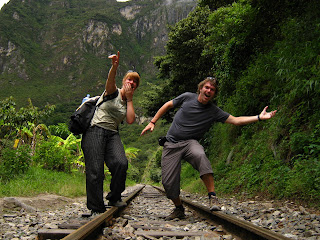
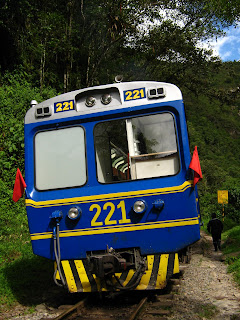
A river cascaded out from the side of a mountain high above us, it´s source a mystery. We imagined a beautiful high plateau with pristine jungle undiscovered by man. In contrast, nearby was the hydro electric station where the path ended and we would walk along a disused railway track beside the river. Disused, yeah right! Not long after a train was thundering towards us horns blaring (thanks Lonely Planet). There was no rest for the river, it was still a torrent of rapids, now surrounded by dense jungle and even higher tree covered mountains.


The railway crossed the river by a dodgy looking bridge. We stand and contemplate which route to take, the foot path with rusty loose metal plating, or on the railway sleepers, with the river in view below. We take the first option. At this point we were still not expecting to see a train coming. We thought how 'funny' it would have been if we´d walked almost all the way across on the sleepers only to have to run back when the train came....


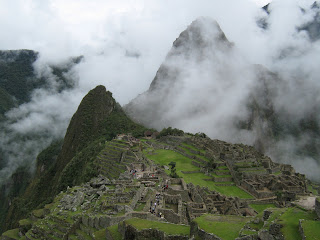
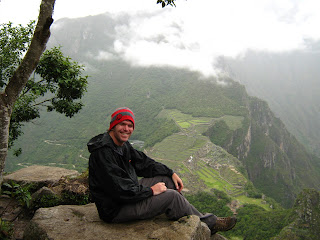
Walking along the tracks cut into the mountainside and the river below us we spot Inca terracing on the mountainside opposite. We felt like explorers of old as we realize this is our first sight of the Lost City of the Incas, Machu Picchu. With Wainu Picchu towering above the ruins and we are in awe of the scenery and full of anticipation for the next days hike to get there.


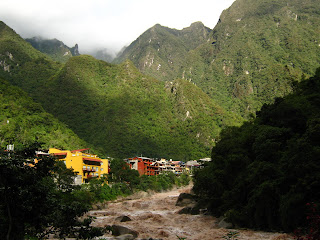
With Machu Picchu in view we knew it was not far to Aguas Calientes, our bed for the night. Chewing coca leaves along the way had eased our 5 1/2 hour passage though the jungle but left us with a fearsome appetite.


Holding out for cheap accommodation we walk to the furthest point in town to the Inti Wasi Hostel which for $5 a night fitted the bill perfectly.

Ouch, we bought our our entrance tickets, $40 each.

Day 3

Awake at 3.30am for the hike up to the ruins, but the rain was beating off the roof of the hostel and we thought better of it.

Instead we went to the Manuel Chavez Ballon Museum and learnt about the history and the discovery of Machu Picchu and had some time to read up on the history of the Incas. Yes I don´t waste all my time drinking beer and chasing girls, and since when was that a waste of time anyway.

Day 4

In the spirit of all things free, we decided to walk up to Machu Picchu and save the $7 that the bus ride would have cost. Setting off in the pitch black at 4am there was just some light rain to keep us company and a few other people doing the same thing. Climbing 450m along steep stepped paths we arrived at sunrise at the the top, 1 1/2 hours later. Although we couldn't´t see the sunrise as it was chucking it down with rain. We were there early to get 2 of the 400 (free) tickets which allow you to climb Wainu Picchu, but more of that later.
After thawing and drying out as the day warmed up I took a little walk around the ruins, up to the gate keepers house to get the classic M.P. photo. We were lucky the cloud cleared a little and there was a little blue sky. It´s a truly amazing setting in the mountains.


Risky Planet

The vertical sides of Wainu Picchu kind of make it look impossible to climb. Several warnings about being in good health, not suffering from vertigo, that the paths are scary but not dangerous and some of the paths will make the heart beat race of normal people did not put us off. We set off undeterred. Lena wanted to go to the Temple of the Moon, half way down the North face of the mountain, so we branched of the main path and found the first ladder to climb down, no problem. The narrow path wound it´s way down and round the mountain. The ruins of the Temple of the Moon I thought were nothing special but the setting in the jungle on the mountain side was really cool.


We guessed the unmarked path leading up the mountain would take us to the summit of Wainu Picchu. It did but not without some heart stopping moments. The Inca built paths are built on the side of steep slopes with dizzying drops to the side. At one point we were faced with a ladder climb up a vertical cliff followed by an narrow Inca stairway carved out of solid rock with only a wire rope to hold on to. Scary but not dangerous, yeah right, one slip or wrong foot would have lead to a fall into the jungle below and certain death. It was a long way back, we had no choice but to carry on. It would be impossible to be in that situation at home with so many safety regulations and for that reason I love travelling so much. I heard stories of people having fallen off Wainu Picchu and it taking months to find the bodies in the jungle. Respect to the Incas, they probably ran up these mountains without a second thought and definitely had no wire ropes to hold on to. The view at the top of the ruins of Machu Picchu was worth the climb but the route down looked pretty terrifying. It´s easy walking down the stairs in your house, but when these stairs are narrow, far too small for your feet, slippery from the rain and you can see the bottom of the valley at least 500m right below you it makes things just a little tricky. Did I once used to suffer from vertigo?


Stairs handled we were soon back to Machu Picchu. With only 1/2 litre of water and a handful of coca leaves between the two of us we´d been hopelessly unprepared for what turned out to be a 3 1/2 hour hike, but fortunately it all worked out fine.

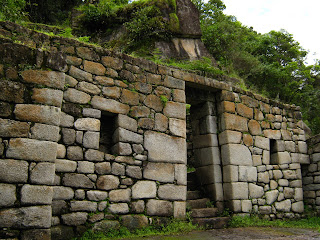
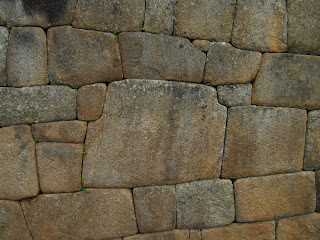
Walking round the ruins late in the day most of the tour groups had departed. I got chance to feel the peace and silence that prevailed over the site for nearly 400 hundred years from when it was abandoned to being rediscovered in 1911. The Inca people who built this site were incredibly skilled, the stone work is amazing.


I left the site at 4.30pm feeling that I could spend another day there, there were still areas I had not seen. I think I tapped into some mystical Inca energy because after all that hiking I still walked back to Aguas Calientes instead of taking the bus (or was that mystical Scottish tightness).

Machu Picchu gets the number 2 spot in the 7 Wonders of Brainworld, with The Temples of Angkor in Cambodia still in first place. I´ll definitely visit Machu Picchu again and maybe do the Inca Trail.

Day 5

Retracing my steps along the railway line to the hydro electric station I made the mistake of taking one of the 'direct' mini buses to Cusco for $13. It ended up taking longer than if I´d taken the public buses. To add to that the driver was clearly insane, finding the smoothest part of the dirt road to drive on regardless if it was on the wrong side of the road, on a blind corner, and not slowing down for pedestrians, animals, towns or anything. Maybe this was just the Peruvian way of driving. Then there was the dead tourist on the road having just been run over by a truck going the other way. This road is used by the jungle mountain bike tours to Machu Picchu. More dangerous than than Death road in Bolivia I think. The poor tourist had not even got as far as seeing Machu Picchu, I still didn´t know if I´d get to tell the story. After 12 hours journey from Aguas Calientes, I arrived safely in Cusco.

Saturday, January 17, 2009

Tales from the Gringo Trail (Part 2)

Bolivia

Leaving the bus terminal I bumped into a Mexican traveler, Roberto, and we walked to the border crossing. Later I discover he is a TV celebrity in Mexico, a kind of Mexican Steve Urwin. The crossing from La Quiaca in Argentina to Villazon in Bolivia was quick and easy. The immigration offices are less than 30 metres apart and arriving at lunch time gave me plenty of time to cross and then buy a train ticket to Tupiza.

Villazon was like any border town I've been to. Narrow streets lines with currency changers and many clothes shops. At 3600 metres altitude the air was a bit thin and a few coca leaves were needed to stave of the tiredness.

Great Train Journeys of the World

The clean and modern train departed from Villazon on time at 3.30 in the afternoon. The first part of the journey was through desert like scenery and scrub. The tracks were very uneven and progress was very slow. Dropping 500m metres we were suddenly in a different world. Towering, eroded red mountains, lush green vegetation and the river next to the railway running red from the iron deposits. In the railway carriage the TV screen was showing the latest 'Mummy' film which was completely at odds with the splendor of the scenery outside. An incredible but short journey of only 3 hours with the train arriving in Tupiza on time. The train continued to Uyuni and Oruro but at night and at an altitude of over 3000 metres this is maybe not so enjoyable.

The Land That Time Forgot

After almost a year and a half of travel I´ve already used all the words I can to describe scenery and landscapes. I´ll have to use them all again but now with ten times the meaning for the landscapes in Bolivia. They are really that amazing(x10). An incredible surprise!

From Tupiza it was a 4 day jeep trip to Uyuni to see the Salar de Uyuni. The worlds largest salt flats. With my three new friends, Roberto, Carly and Judy, we had hired a jeep with driver and cook for the trip.


Departing from Tupiza early the next day the old Toyota Landcruiser struggled up the steep mountain road out of Tupiza, battery terminal coming off making the jeep suddenly stop and finally over heating at the top. No problem our driver was a top class mechanic, using muddy water from a puddle for coolant he had it all sorted while we took photos of the scenery. For some reason we all had complete faith in our driver and jeep for this 4 day journey to the back of beyond. Our drivers skills were again shown fixing a puncture, using an axe the on the wheel's split rims.


The journey took us up to the snow line and down past small towns and nearby mines, herds of llamas. Passing colourful lakes and rainbow coloured mountains I would not have been surprised to see hunter gatherers chasing long extinct animals.


Travelling through this alien landscape I arrived at Lagoona Colarada. If this was an alien landscape, the flamingos were the perfect alien birds. The bright pink birds feeding from the red lake, red and yellow mountains behind, if I´d have seen this as a photo I´d have thought the colours had been changed on it.


Before we reaching the salt flats we cross the railway that links Bolivia to Chile the coast. Bolivia lost the War of the Pacific against Chile and as a result has no coast line. The Chileans built the railway from the coast to Bolivia as a consolation to allow trade to the sea. Bolivia still disputes this loss of land. The Bolivian Navy is now restricted to patrolling the waters of Lake Titicaca.
Millions of years ago when South America was flat, Atlantic Ocean reached far into the continent. With the action of the earths plates and the formation of the Andes part of the sea was enclosed by mountains and lifted up to a height of 3500m. The water evaporated and Salir de Uyuni was formed. The largest salt flats in the world. Climbing on the rocks at the edge of the salt flats it was amazing to find the rock were in fact coral from the sea that was once here. On top of the coral was lava from the many surrounding volcanoes.


We were up 5am to drive out onto the salt flats and see the sunrise. With the cold temperatures and white everywhere outside it felt like we were driving through snow.


Bad bus trips of the world

The bus journey from Uyuni to Potosi was entirely on 'dirt roads' and sometimes using convenient dry river beds, a roller coaster of a trip through the mountains. Along the side of the bus was written 'Comfort Security and Elegance'. This I found highly amusing on this 20 year old bus with luggage on the roof, no leg room and the aisle filled with people standing for most of the six hour journey.

Potosi

Bolivia was full of surprises, Potosi at 4060 metres above sea level is the world's highest city, I was expecting a drab and bleak city. I was greeted by a city of elegance, colour and vibrancy. Once the richest city in South America in Spanish colonial times, created from the nearby silver mines in the mountain that towers over Potosi, Cerro Rico.


The mines financed the Spanish Empire for over 200 years. The mountain has the name 'The mountain that eats men alive'. Maybe as many as 8 million people have lost their lives in the mines in Potosi, mostly indigenous people and African slaves who were forced to work for 20 hours a day in appalling conditions. People work in the mines today, still in medieval conditions. The mines are full of toxic dust and silicosis is a major problem, once the miners contract this illness they only live a few years more. The American film 'The Devils Miner' made in 2005 shows the life of a 14 year old boy working in the mines, watch it and you´ll see what I saw here. I took a trip into the mines and was horrified with the conditions. Walking through unlit tunnels climbing ladders into a tiny enclosed space, I watched a miner hammering at the rock to create a hole for a stick of dynamite. I was almost suffocating from the lack of air and the dusty atmosphere. I was told by the guide that this miner would work here for 10 hours he and was already dying from silicosis. The miners chew on coca leaves which helps them deal with the conditions. Below ground they pay homage to the god 'El Tio'.


The Spanish mine owners created this god to scare the indigenous workers. They give alcohol, cigarettes and coca leaves as an offering to El Tio in return for his protection. We took gifts for the miners and their children. The families live beside the mines so they can stop their equipment from being stolen.


The Cerro Rico was once 1000ft higher and it is now forbidden to remove material from the summit, so the city´s landmark doesn´t disappear forever. Last year 15,000 miners were working in the mines but now there are only 5,000 due to falling mineral prices and as a result mining is no longer the main industry in Potosi. A far cry from the colonial days.

Later when visiting the Casa de la Moneda (The Royal Mint museum) it is very ironic that after years of Bolivia producing coins for Spain, Spain now produces some of the coins for Bolivia. Inside the museum, the giant wooden machinery used to produce the strips of silver for the coins was perfectly preserved by the high altitude. When the mules which powered the machines died, they used slaves from Africa instead.

Risky Planet

Sucre had been the scene of recent riots and fighting. On the streets there was no evidence of this and the city had returned to normal. Country people fighting with town´s people fighting with the police. A complicated situation that I can´t begin to explain. Bolivia is a divided country on many levels, geographically, politically and ethnically. The majority are indigenous people, who are poor and live in the highlands. The rich minority live in the lowlands that include the mineral rich areas of Santa Cruz and Tarija and are of Spanish desent. El Presedente Evo Morales (the first indigenous president) was discussing redistribution of wealth from the lowlands to help the large population of poor people in the highlands. This sparked a revolt in the lowlands with rioting and talk of the separation. A referendum was announced and the country was at peace.

Travelling through the highlands of the country he has almost complete support, every building has Evo painted on the side of it and a big tick.

Sucre is the Judicial Capital of Bolivia and has many fine buildings all white washed. It´s a fantastic city and not at all what I expected to find in Bolivia!


Happy that Sucre was a safe place, for the time being, I decided to make it my home for Christmas and New Year. I would also be away from the back packer hoards in the bigger towns. I contacted the Fox Language Academy and enrolled for more Spanish lessons and also volunteered as a classroom assistant to help teach English to under privileged people. The school is non profit making and the money I paid for Spanish lessons helped to pay for under privileged people people to learn English.


I spent Christmas Eve at the house of the School's director with his family and friends eating traditional food. Christmas Eve is a sober affair in Bolivia, New Year's eve is when they party. My Spanish teacher had asked me if I wanted a lesson on Christmas day, I was a bit surprised but agreed when she told me her husband was unemployed and she needed money to by her children presents.

The out stretched hand begging for money was an all too common sight in Sucre. The poor people go to the main square on Christmas morning hoping to be given food or anything. A few of us at the hostel grouped together to buy some food to give out there.

On New Year´s eve there was a big celebration in the square with music organised fireworks and more concerning, everybody elses fireworks. It was 200 hundred years since the start of the revolution against the Spanish colonialists.

La Paz

Arriving to La Paz by bus is one of the most amazing way to arrive to the city. Driving along the edge of the high plateau the whole of La Paz can be seen in the valley below. It´s almost like flying into the city. It´s an incredible city, very busy with chaotic street markets everywhere. Culturally interesting with very high quality museums and art galleries.

The Coca Museum was very informative about the indigenous peoples use of the coca leaves. The leaves act as a mild stimulant, allow you to work longer and stave off hunger. They are also nutritious and help the effects of altitude and are not addictive. The indigenous people have used the leaves for thousands of years and it is part of their culture. I personally found a cup of coca leaf tea in the morning most enjoyable. The USA is trying to eradicate all coca plants in South America because of their use in the manufacture of Cocaine. Evo Morales (an ex coca plant farmer himself) has expelled the US Drug Enforcement Agency from Bolivia with the reasoning that the cocaine abuse is a problem of the USA not Bolivia.

Each afternoon there were demonstrations along the main street. Camposinos (country people) marching with shirts off, flying the multicoloured indigenous flag and letting off homemade fire crackers. It sounded like a war zone and the police were out in force with riot shields. A sinister squad of police motorcyclists prowled the streets with the pillion holding a rubber bullet gun with a fearsome stack of ammunition on the waist. We´re told to avoid political demonstrations in case they turn nasty but this was irresistible to watch.


The World´s Most Dangerous Road

Quite a claim. Built by Paraguayan prisoners of war in the 1930's it was once the only road between La Paz and Coroico. Ironically the Paraguayan´s are still managing to kill Bolivians long after the war was over. Before the road was 'closed' to traffic an average of 100 people were killed every year. I had seen photos of the road with trucks passing each other and massive drop offs at the side of the road. A new road has been built now and the road is 'almost´only used for down hill mountain biking. 64km long with a vertical drop of 3345m.


Not recommended in January and February due to the rainy season and resultant landslides, but what the hell, it couldn´t be that bad and there was no way I was going to miss this opportunity. Kitted out with super cool down hill mountain bike, with massive suspension travel, disc brakes, tyres that wouldn´t have looked out of place on a motorbike and a full face crash helmet the 'Downhill Madness' was to commence. 24KM on tarmac loosing 1000m then 4km up and down. These beasts were not designed for going up hill, undeterred 4 of us cycle the section, the rest go in the minibus. We reach the 'death road' itself, a dirt road with no crash barriers, many crosses mark where people have died. Exciting stuff.


The Corners of Death being the most exciting with the road cut into near vertical cliff with 100´s of meters of drop to the jungle below. Waterfalls cascaded over the road. All very safe though, we only meet one jeep going the other way. Without traffic it´s now pretty safe, the guide kept the speed down and I found the bikes weren´t geared for flat out speed, but I guess the consequences of crashing could have been fatal. The scenery was amazing, the experience of cycling though the mountains of Bolivia was unmissable and riding a Rockymountain DH bike worth $3500 was awesome.


On route to Peru was Lake Titicaca and the Isla del Sol (Island of the Sun) important in Inca mythology as the birth place of the sun. A tranquil island to spend a day or two and it´s incredibly beautiful. A fitting end to five weeks of travel in Bolivia where I found the people friendly and welcoming and the country was generally safe to travel in, but maybe I´d been lucky again.

Since leaving Bolivia I learned that Evo Morales has won the referendum to change the constitution in favour of the majority, the indigenous people. In Sucre I witnessed the NO campaign with posters likening Evo Morales to other South American dictators such as Pinochet and Hugo Chavez. He may not be perfect but having seen the poverty at first hand in Bolivia I cannot argue against his reasoning to help the poor majority. I hope and wish for peace and prosperity in this beautiful country.

Sunday, November 23, 2008

Tales from the Gringo Trail (Part 1)

Chile con carne

Ten hours after leaving the relative safety of Auckland I landed in Santiago in Chile. Another continent and the start of a new adventure.


I was not too impressed with Santiago. Some parts of the centre of Santiago resembled a concrete jungle, the main square being an exception. The drab gray buildings along the narrow streets block out the sunlight. The years of Pinochet and his repression are still evident. Compared to other capital cities I´ve been to it was a little disappointing. Where the architecture was not impressive, the street art / graffiti most certainly was, especially in the Bellavista area. Many buildings were covered with amazing colourful artwork and there were some interesting museums.


The Chileans are big drinkers and Bellavista was the place to see this too. The street bars full of people from 6pm until the wee small hours. Except for the the Saturday night I was there, when all the bars closed at midnight because of an election the next day. No drinking on election day and it´s illegal not to vote.

I visited the Museum of International Solidarity, it was in memory of Salvador Allende Gossans, the president of whose government was overthrown in a coup in 1973 by General Pinochet, with help from the USA. He supposedly committed suicide. There are many art works with anti US sentiments. The art works were hidden during the Pinochet years.

I love Valpo

Two hours on the bus and I was in Valparaiso, a once rich port city on the Pacific coast until the Panama Canal was opened. Now a decaying but atmospheric city that is slowly being restored. It is a UNESCO heritage sight and is built over a number of hills which have ancient elevators (ascensors) to save you having to climb up. Most of the city´s buildings were destroyed by an earthquake in 1862. The shells of some of these buildings still stand near the port.


Brightly coloured houses and buildings next to crumbling slums. It's best not to stray too far from the busy streets, there's always a presence of danger lurking in the shadows. The streets are brightened by some amazing street art / graffiti. The girl's tee shirt said 'I love Valpo', the heart was crossed out and she was missing her hand bag, maybe she'd been unlucky and had it snatched.


Valparaiso is the home of Chilean Armada (Navy). A retired Captain of the Royal Navy, Lord Cochrane, arrived in Chile in 1818 and became head of the Chilean fleet with the rank of Admiral. Under his command the Chilean Armada defeated the Spanish Armada which led to an independent Chile.
Not really knowing where I was going next, I find I can get a bus from Valparaiso to Mendoza in Argentina. An amazing bus journey over the Andes. The mountains were incredible . Aconcagau could be seen form the bus in all it´s glory towering above us at 6962 metres high.


Don´t cry for me......
Crossing into Argentina was an easy process with no hold ups. At customs we all had to get off the bus, but instead of our bags being checked a cup was passed round for tips for the customs officials.

I arrived in Mendoza and the contrast with Valparaiso could not be greater. The tree lined streets felt safe and the atmosphere was relaxed. It is literally an oasis in the desert, I was told it only rains 3 or 4 times a year. It rained 5 times during my stay! The city was destroyed by an earthquake in 1861 and completely rebuilt with a wide streets and a main square, Plaza Indepencia and four smaller squares, Plazas Italy, Spain, Chile and San Martin. If another earthquake struck the people would be safe in these areas. The beautiful San Martin Park was great for walking in and the park gates were even made in Scotland.


The Italian influence in Mendoza is very obvious with the people dressing with style and many expensive shops. If it wasn´t for the amount of ancient cars on the roads it would be easy to mistake it for a city in Europe.

As well as Jesus, the trees are the savior in Mendoza. No one would live there without them. It´s possible to walk in shade through most of the city. With temperatures in the mid 30´s this was a welcome relief. Between the pavements and roads are a system of aqua ducts that provide water for the trees. The trees also help absorb some of the pollution that belch from the ancient cars that choke the streets. With a 50% import tax on imported goods even the oldest most wrecked car is still worth something.
I was soon getting into the local way of life; taking mate (a herb drink) and siestas, eating far too much steak at the many asados (BBQ´s) and drinking the local wine. I enrolled with a school to learn Spanish and end up staying for 3 weeks. I was lucky that I met a girl, Mariana, who could help me with my Spanish in return for helping her with her English. It´s difficult socialise with local people when travelling so it was great going out with her and her friends. She was from Buenos Aries but had moved to Mendoza to escape the rat race.

My first long bus journey took me to Tucuman. Maybe you would think that 15 hours in a bus was unbearable but the seats recline, there´s plenty of room and food and drinks are served. They are very luxurious compared with the buses back home.


Tucuman was in the middle of a heat wave when I arrived The streets were deserted, everybody taking their siesta, this was really the only option. The next day the local paper reported the temperature as 39 deg C, with the highest energy demands in the country ever. Strange seeing Christmas decorations in the summer.

Don´t mention the war...

I arrived in Cafayate in mid afternoon, that meant siesta time and everything was closed. I got invited to sit with three old men outside a cafe. They told me they like Scottish people but not the English because of the war over the Falklands. I nod in agreement and say how bad it was, not wanting to add that there were Scottish troops fighting on the front lines.... Peoples' confusion over which countries actually makes up the UK is usually to my advantage. They were all poets and gave me some of their poetry books. Later they invite me to a recital and we share wine bread and cheese. They wanted nothing in return but the next time I´m in Cafayate I have to bring some poetry from Scotland for them.


The town was really nice. A large central square full of trees surrounded by colonial style building and a pretty church. The countryside is full of vineyards the town produces some good wines. A morning was spent visiting some of the Bodegas (wine cellars) to taste the wine. The Torrontes was particularly good.


Nearby was an area called Quebrada de las Conches. The road winds it´s way through amazing coloured mountains, red and green from iron and copper deposits. Strangely eroded mountains and enormous ravines where mighty rivers once flowed and cauldrons where waterfalls once cascaded.


Salta is home of the Archaeological museum of the high Mountains. This houses 3 Inca mummies which were found on Volcan Llullaillaco in 1999. They were perfectly preserved by the high altitude and freezing temperatures. Only one is on display in the museum at a time. The little boy,with his head resting on his knees, looked like he would wake from his sleep at any time. Salta was a great place to stay for a few days. It was vibrant city and had beautiful buildings, churches.


Two nights in Tilcara to let me acclimatize to the altitude, now 2500m. Adobe buildings, dirt roads and many indigenous people. I´d left the modern Argentina behind.


Many artists and musicians have made this their home and I was lucky to be able to go to an evening of folk music, with guitar, accordion and singing. High on a hill above the town was the remains of and ancient city, Pulkara de Tilcara, dating from 1500BC. More impressive were the huge cacti growing through the remains.


I sat high up on the hill watching lightening hit the mountains on each side of the valley. Better get to safety, the riders on the storm were coming.


Between Tilcara and Humahuaca the road passed a little sign letting the passengers on the ancient bus know that they had crossed the Tropic of Capricorn. On one side of the bus amazing mountains coloured red and yellow from iron and sulphur deposits, on the other side the Rio Grande and old railway tracks, at times suspended in air where bridges had been washed away. Only the ghosts of long forgotten trains follow these tracks now. My time in Argentina was nearly over but not before a stop in Humahuaca, another town of adobe buildings, cobbled streets and 3000m above sea level. Finally a short two hour bus journey to the border with Bolivia at La Quiaca. The scenery was changing, the towns were changing, the influence of Bolivia becoming apparent. A little taste of things to come.


Reaching the border at lunch time was no problem with only a short queue of people. There were hundreds of Bolivians crossing the border with huge amounts of goods but they didn't seem to need to have any documents checked. I was full of excitement and anticipation with the thought of traveling in Bolivia, crossing into the unknown, new people and a different culture.

Argentina is the 8th largest country in the world after India. Visiting the cities, it's easy to think that it's a modern and developed country. The run down areas and slums on the edge of the cities say otherwise. The country is slowly recovering from the financial crash in 2001 but with inflation at 25% and wages not increasing, it's tough for ordinary people to get by. With many natural resources including minerals and fertile land, and only 40 million people a full recovery is a possibility. Unfortunately the gap between the rich and poor is getting bigger and 25% of the population live in poverty.
On a positive note, it´s an amazing country to visit, with incredible landscapes and welcoming, friendly people. I plan to return to Argentina and visit Buenos Aries at the end of this trip.

Saturday, August 23, 2008

Turn on, tune in, drop out

Train Spotting

Choose life, choose a career, choose a job, choose a flat screen TV...... Life is what you make it. For the last year my life has been a kaleidoscope of changing cultures, different people, amazing cities and landscapes . I chose to carry on my adventure around the world.

The prospect of returning to Scotland and resuming my previous life was not a path I was willing to take. Continuing my life 'off the grid' was way more exciting. Careers and job offers were of less importance, reality yeah that's a scary prospect, or has my escape from reality in fact become reality? Regardless, I'm going to carry on for now until my luck or money runs out. After a brief visit back home to Aberdeen my journey was to take me back to New Zealand for the winter and then onto South America.

The decision had been made in early March to return to New Zealand, with my season pass and air ticket bought. It felt like returning to a second home. Revisiting familiar haunts like Methven and Mount Hutt. Later Queenstown.


The Winter Season
Snowboarding, women and drinking. Not always in that order but dependent on mood, circumstance and the ever unpredictable New Zealand weather. It's a fine balance and hopefully not too much of a compromise. The wind blows, the mountain closes, snow falls heavily and the access roads are closed. Frustration and boredom, never far away, just as well snowboarding is not my only passion in life. On a good day, a car full of friends, good music, full of excitement and anticipation, racing up the ski field road. On the mountain, powder snow and bluebird sky's, seeking out the best lines and untracked snow. The weather closes in or the light goes flat, it's time to sit around and drink coffee. When the mountain is shut it's time to relax or party, play pool in the pub or get drunk and chase the snow bunnies. With hard work and some luck it all works out well.

I spent most of the season in Methven, staying at the Mt Hutt Bunkhouse again. I knew I would be amongst familiar faces there, with many friends returning from previous years. Trips were made south to Queenstown and Wanaka, but for me it was Mt Hutt, Porters and the club fields where the action was at.


Old Timer, yeah right....

I walked into the common room of the hostel in Queenstown, blimey they're getting younger, or am I just getting old? Yeah, you can keep your comments to yourselves please. My behavior disguises my age, I'm told. Plenty of time to grow up, just don't grow old.

I met my fellow old timer and long time friend JD at Queenstown airport. I had a week to take him to some of the ski fields and show him how wonderful New Zealand is. The Remarkables, Coronet Peak, Treble Cone, Ohau and later Mount Hutt. After a shaky start with the weather we find powder snow and blue sky at Treble Cone and Ohau, but not without the inevitable hiking to get there. Awesome runs and the comment 'this is the stuff of snowboard DVD's' reminds me why I love snowboarding here so much. It had been over 2 years since we had last met and it was great to catch up and find out the gossip and drink whisky. It was inevitable we'd end up doing a bungy jump and this was done at the Kawarau Bridge, the original bungy. Alas JD's (snowboarding) fun was cut short by the arrival of his girlfriend Sam.
It was a winter of reunions with Ianzie, another old timer and biker friend from Aberdeen, visiting Wanaka with his girlfriend for a week of skiing.

Mt Hutt

Towering high above the patchwork quilt fields of the Canterbury Plains, Mount Hutt gives incredible views across to the Pacific Ocean and behind of the Southern Alps. We grumble about the closed days here, but when it's a powder day it rocks.


There is some challenging terrain at Mt Hutt but to escape the crowds a trip out the back towards North Peak is required, not forgetting to leave our intentions with ski patrol. Out there we were on our own, we hoped. Thankfully my good friend Hamish was leading the way, a veteran of at least 8 seasons at Mt Hutt. We ride down from the ski field boundary, then hike for 30 minutes. Out of nowhere a group of telemark skiers appeared and stole our fresh tracks. We needed to get our breath back first but there was a massive snow field in front of us with plenty of room for everybody, on the perfect spring snow. We set off in complete silence on the mountain, no wind and blue bird skies it was an amazing place to be.


The season's not complete without the Mt Hutt Peak to Pub race. A 2km snowboard, a 17km mountain bike ride down the skifiled access road and a 10km run to the Blue Pub in Methven. Junko, Giles and I entered the mixed teams race and came 10th out of 20 teams which was pretty good considering we did almost no training. I did the mountain bike section which was very exhilarating if not a little dangerous. The access road has some fearsome drop offs. A friend ended the race in a ditch with cuts and bruises and one of the main sponsors, Big Al, had to be air lifted to Christchurch hospital with a broken neck! Even so, there was still a great atmosphere after the race at the Blue pub.

Give me a job now, please!

My third season of snowboarding in New Zealand without working. I think I qualify with an outstanding A++ as a certified ski bum. It was time for this to change. I enrolled in a course to become a snow board instructor. Four days of assessment, instruction, late nights studying and a teaching assessment on the final day. This was bloody hard work but really good fun and very rewarding. I even passed! So my riding has improved, I learned lots and now I'm an unemployed snow board instructor, where will it all end?

The Clubbies

It has taken me the best part of 3 winter seasons but I have now discovered the true nature of winter sports in New Zealand. The club fields are like nothing I've ever been to before. Difficult to get to, hard work when you're there, but very few people, a great atmosphere and definitely the best terrain. A spirit of adventure and a fair amount of determination are required to enjoy them to the full. We all agreed the days at the clubbies were amongst the best of the winter. Damn it, I need another season here.....

Trip to Mount Olympus Ski field

The Playground of the Gods..... their words not mine. This was surely going to be something very special. A 65km drive from Methven, more than half of this on dirt roads, the adventure started way before we reached the ski field. Turning off from Ryton Road onto the single track access road, we were surrounded by towering snow capped mountains and rugged tussock moorland. This was wilderness to rival anywhere else I'd seen in NZ. The road wound its way along the gorge high above on the mountain side. Passing an oncoming car, with only inches to spare on one side and a several hundred feet drop on the other my concentration was dialed in. On this type of road I've usually been at the mercy of some local lunatic bus driver. Today my passengers Toby and Lewis were at the mercy of my driving.


Approaching the ski field we reached the 'bottom hut', where we radioed our intentions to the ski field of our arrival. This was to ensure there was no downward traffic on the very steep and narrow final section to the car park. Snow chains fitted the car ground it's way up the bumpy and rutted road which was hardly suitable for the 2 wheel drive car we were in.


Apart from the flash 4x4's in the car park the scene that greeted us could have been from the 1950's. An old fashioned rope tow up the mountain. Yeah these are scary!!! Wearing a harness with a nut cracker device attached, first grab the rope and once traveling at the same speed as the rope attach nut cracker to rope and hold on. It may be old but it's rapid transit up the mountain. Sounds easy? I'd take a chairlift any time. When riding the tow the nut cracker passes over the pulley wheels with a resounding metallic clunk. With my fingers only inches away I disliked it every time.


This mountain is not for the faint hearted, there is no grooming and no pistes. The whole area is there to be shredded. To give some idea of the terrain one area is called 'Little Alaska'. Another run is called 'International Wife Swappers'. The club members must have some good parties in the club house. Shame I'm not married.

Unlike the commercial ski fields I've been to, the lifts here didn't shut at 4pm. When we asked the closing time, the answer was when the last person has had enough. This and the relaxed and friendly nature of the handful of people that were there made it a super enjoyable day. Amazing terrain, great snow and wonderful views, it had been all I'd expected and more. Snow boarding at it's best.

Trip to Temple Basin Ski field

Transworld Snow Boarding magazine were quoted as saying 'If I had to stay in one area, on one mountain to snowboard for the rest of my life, it would be Temple Basin. It's that good!' FHM magazine voted Temple Basin as the greatest adventure escape worldwide and said it's arguably has the hottest snowboarding terrain in the Southern Hemisphere


This was one ski field I had to get to, so when some of my Japanese friends, Toby, Kazu Shiba and Teru, said they were planning a trip I jumped at the opportunity to go. It was my no means easy to get there. After a 2 hour drive to Arthur's Pass we were faced with a 50 minute hike up the mountain to get to the ski area. Fortunately there was a goods lift to carry all our gear up.


The skies were clear, the snow was good and the rope tows and nut crackers were were becoming easier to use. Along the walking track to the second tow and then more hiking to the ridge above. This was pretty scary, walking along the narrow ridge to get some fresh lines in the snow. The terrain was steep and really hard work, long traverses to reach challenging chutes. Again no grooming, this was all 'off piste' and with fewer than 10 people on the mountain it had a real wilderness feel.

At the end of a great day Toby and Kazu were showing off with their tricks on the kicker in front of the lodge to every one's great amusement when they got it wrong.

After a comfortable night in the mountain lodge we were greeted by cloud and rain the next morning. It was snowing higher up but after a few runs we were all shattered from the difficult conditions so retired to the lodge for lunch before the hike back down the mountain.

So the magazines were right and if I needed only one reason to move to New Zealand it would be so I could snow board at Temple Basin....

Trip to Craigieburn Valley Ski Area

I was nervous about going to this ski field. The area is for adventurous and advanced snow boarders and skiers. To ride the rope tows 'goofy foot' it is recommended you are of advanced level snow boarding. There are even triple black diamond runs here marked as suicidal! Even the access road was hair raising. A single track road cut into the mountain side with a shear drop of several hundred metres to the side.


It was going to be a hard day for me, trying to keep up with my two ski instructor friends Giles and Shiba. The icy and sloping up track of the rope tows didn't make things easy but I was soon up to the summit and we were soon heading down the less suicidal chutes, across a beautiful snow field, passed the closed signs and down to the access road. Ski Patrol are never amused when closed signs are ignored and I should know the snow responsibility code by now, but here they said 'cool you made it down, just be careful on the snow covered creek, it's beginning to break up'.


A big hike up to Hamilton Peak in the bright spring sun and then the run down Hamilton Face. The top was in the shadow of the sun and was sheet ice and steep, this fortunately turned to perfect spring snow very quickly and we all had grins from ear to ear at the bottom.

Craigieburn and Broken River Ski field together form the largest off piste area in New Zealand. Another great day was spent exploring Broken River.

End of another Season

The snow boarding was awesome, the drinking and partying were in moderation, sometimes, and the women, well that's another story altogether.
So where will it all end? I don't know, I plan my life around snowboarding, when can I do another season... I think passion has become obsession!


The winter crew (not all in the photo and in no particular order): Hame Dawg & Junko, Tim & Kazuha, Giles (Mr Bunkhouse), Shiba, Toby, Kazu, Mitsu, Kalvin, Andy, Mel, Iyo, Iyumi, Yukiko, Lisa, Kaulu, Yoshimi, Aiko, Antje, Sarah & Ellie in QT and probably a few others.... See you all next year!